
singrass provides "indoor green lung" with "People oriented"

Nowadays, high-rise buildings are becoming more densely packed and towering than ever. Many of these structures are completely sealed shut; even those with windows mostly feature narrow, inward-opening gaps that are incapable of generating proper air circulation. This lack of fresh air is exactly what causes Sick Building Syndrome.

In this context, it is more urgent than ever to bring the ecological vision of the Singapore Botanic Gardens indoors. By leveraging smart indoor ecosystems, we can transform every high-rise into a 'vertical oasis.' Ultimately, immersing the people working, studying, and living in these buildings in an environment that feels like a primeval forest is the only sustainable way to overcome Sick Building Syndrome.

The SINGRASS® Indoor Smart Eco System™ (ISES™) provides an integrated, dual-purpose solution that empowers health across two key dimensions: breathing and nutrition:
• Build thriving indoor plant communities with leafy greens to craft a healthy, sustainable environment.
• Convert indoor spaces into ecological farms for complimentary access to the freshest, zero-pollution produce.

The SINGRASS® Indoor Smart Eco System™ (ISES™) delivers six dimensions of value: Eco-Landscaping, Eco-Functionality, Eco-Farming, Emotional Well-being, Carbon Sequestration, and Economic Value.

Ecological Landscape A. Utilizing 36 varieties of leafy greens and herbs and powered by our proprietary SINGRASS® Indoor Smart Eco System™ (ISES™), we cultivate indoor plant communities that increase microbial diversity and simulate the ecological environment of a primeval forest. B. By leveraging these leafy greens and herbs to create indoor ecological landscapes, these plant communities effectively alleviate eye strain and mental stress, elevate mood, boost the immune system, and enhance concentration.

Photo taken in Shenzhen, China Ecological functions A. The photosynthesis of leafy greens and herbs requires a CO2 concentration of 1,000 to 1,500 ppm. This effectively mitigates elevated CO2 pollution in sealed, windowless environments or air-conditioned spaces lacking natural ventilation, ultimately maintaining the optimal concentration of under 1,000 ppm. B. During their growth cycle, these leafy greens and herbs capture and absorb formaldehyde through their leaves and root systems. Once absorbed, the formaldehyde enters the plants' carbon metabolism network and is ultimately converted into harmless substances such as sugars. C. Conventional air purifying agents are almost exclusively chemical-based. While they can partially neutralize and degrade airborne formaldehyde and TVOCs, they often leave behind formaldehyde and chemical residues, resulting in secondary pollution.

Photo taken in Shenzhen, China Eco-Farming A. The SINGRASS® Indoor Smart Eco System™ (ISES™) creates a sustainable eco-farm characterized by 'low input, low energy consumption, and zero waste.' It yields leafy greens and herbs as zero-marginal-cost by-products that are exceptionally fresh, pesticide-free, and require no supply chain traceability. B. To guarantee the effective intake of their comprehensive nutritional profile, leafy greens and herbs must be consumed immediately upon harvesting.
C. The vital nutrients in leafy greens and herbs—particularly vitamins—are rapidly depleted during logistics, distribution, and processing. Research by American scientists indicates that just 12 hours after harvest, the vitamin content in spinach drops to less than 10%.

Photo taken in Shenzhen, China Emotional Value
A. The growth cycle of leafy greens serves as a dynamic display of nature. As the vibrant leaves expand and flourish over time, this inherent vitality fosters a renewed sense of energy and optimism among building occupants. B. Plants significantly influence human emotional regulation. Indoor spaces enriched with natural greenery play a crucial role in positive emotional arousal—stimulating dopamine production, inducing a profound sense of well-being, and elevating overall subjective comfort. This results in a consistently relaxed, pleasant, and tranquil environment. C. Expanding the visual presence of greenery within indoor spaces effectively enhances concentration. It significantly boosts cognitive function, comfort levels, creativity, short-term memory, and task accuracy, thereby maximizing overall learning and operational productivity.
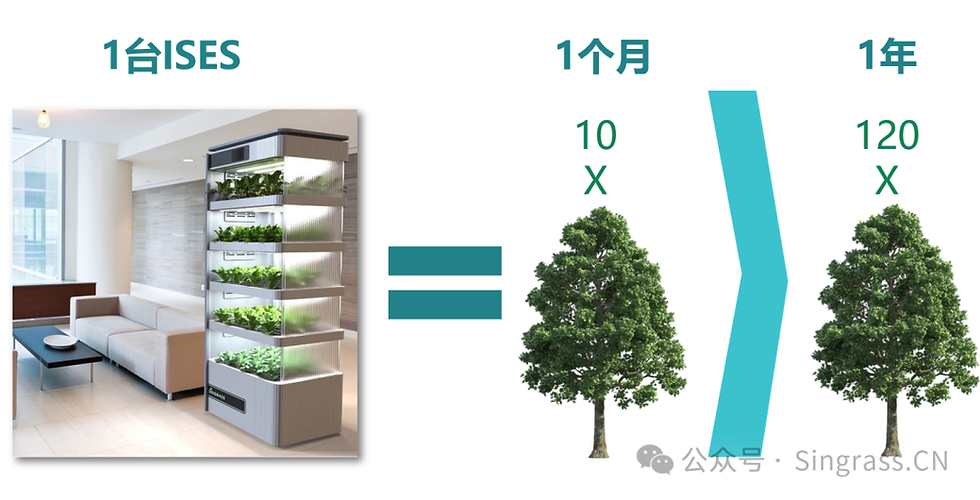
Photo: SINGRASS Carbon Sink Value
A. According to an authoritative report by TÜV SÜD, producing an equivalent yield of leafy greens with the SINGRASS® Indoor Smart Eco System™ generates nearly four times less carbon emissions compared to traditional indoor farming. B. Based on calculations from the TÜV SÜD report, the annual carbon absorption capacity of a single SINGRASS® system is equivalent to that of 120 mature trees.

Photo taken in Singapore Economic Value A. The SINGRASS® Indoor Smart Eco System™ (ISES™) creates a sustainable eco-farm characterized by 'low input, low energy consumption, and zero waste.' It yields leafy greens and herbs as zero-marginal-cost by-products that are exceptionally fresh, pesticide-free, and require no supply chain traceability. B. It completely eliminates hidden supply chain costs by achieving four absolute zeros: zero single-use packaging, zero cold-chain energy costs, zero harvest-to-plate food waste, and zero pesticide use.

Photo taken in Singapore In today's fast-paced urban environments, health and sustainability have become central priorities. We expect the air we breathe to be pristine, the food on our tables to be safe and fresh, and our everyday spaces to foster a deep connection with the natural world. The SINGRASS® Indoor Smart Eco System™ (ISES™) was developed to fulfill these multifaceted needs. Seamlessly blending advanced technology with natural processes, it cultivates an environment of health and harmony indoors. The system enriches the daily workplace with high-quality oxygen, preserves maximum nutrition through on-site harvesting, and fosters a sustainable ecological balance between plants and microorganisms.


Comments